05 November 2007


21 August 2007
Cave of Zeus on Zas, Naxos
Well, it's big and its dark and I need to go back because I didn't explore it as much as I would have liked.
The most amazing thing was the number of tourists trying to get up there in the midday sun with flip-flops, no hats and no water (and of course, no torches).
The cave itself is mainly a large breakdown chamber with some interesting bits for exploring into the "floor". Most of the floor is covered by a black slime, which looks like it could be many centuries of sheep shit, but I may be wrong. There are shards everywhere as well, mostly coarse, but some recognisable as classical. I hope to write more when the photos come and I have processed the sketch map I made on site.
The most amazing thing was the number of tourists trying to get up there in the midday sun with flip-flops, no hats and no water (and of course, no torches).
The cave itself is mainly a large breakdown chamber with some interesting bits for exploring into the "floor". Most of the floor is covered by a black slime, which looks like it could be many centuries of sheep shit, but I may be wrong. There are shards everywhere as well, mostly coarse, but some recognisable as classical. I hope to write more when the photos come and I have processed the sketch map I made on site.
25 June 2007
Farewell Zenas
The Greek caving community is mourning the sudden loss of Ioannis Zenas. Iannis maintained the site Spilaio for years and initiated the very popular WCN which did a great deal to further the dissemination of caving news internationally.

You will be missed.
You will be missed.
27 November 2006
New personal depth record
My new personal best for depth is now -315m, after a good long stint in Propantes. a group of us went up at the weekend with enough rope to rig a good 250 meters beyond the lead we were intending to push, but things (starting with the strength of the rock, but also the morphology of the place) were against us.
The rest of the group - everyone apart from Erato and myself went through the narrows at -315m into the "new sections" of the cave but came to a dead end a little further than they had gone last month. There is still a lot more work to be done.
And of course, the weather was fine while we were entering and while we were inside (although it was raining inside from the drippings of the humidity) and a little before the last man came out, the rain started. It drizzled, then it picked up, then it worsened, then it got better - like this, right up until about two pm the next day - so we packed our tents and got everything together in the rain, and mud everywhere, in the cave, out of the cave, in our hair, in our sleeping bags - mud everywhere.
Anyway - I am not as hampered by excesses of lactic acid as I was during my first wisit to the cave, but I am a little sore here and there and a little bruised from my chest harness.
In all though, the new personal best was worth it, as was the fun to be had all weekend with the other boys and girls.
The rest of the group - everyone apart from Erato and myself went through the narrows at -315m into the "new sections" of the cave but came to a dead end a little further than they had gone last month. There is still a lot more work to be done.
And of course, the weather was fine while we were entering and while we were inside (although it was raining inside from the drippings of the humidity) and a little before the last man came out, the rain started. It drizzled, then it picked up, then it worsened, then it got better - like this, right up until about two pm the next day - so we packed our tents and got everything together in the rain, and mud everywhere, in the cave, out of the cave, in our hair, in our sleeping bags - mud everywhere.
Anyway - I am not as hampered by excesses of lactic acid as I was during my first wisit to the cave, but I am a little sore here and there and a little bruised from my chest harness.
In all though, the new personal best was worth it, as was the fun to be had all weekend with the other boys and girls.
24 November 2006
Back to Parnon
I spent last weekend up on the Paliochora plateau again, the last weekend of the season. Next year again - and all of winter to complete the write-ups.
This weekend, going back to Parnon, a little further south, this time, to the famous Propantes. Currently at -315m officially, a little more in practice and hopefully, by this time tomorrow, a lot more in practice. I am not making any promises about writing anything about this, as this year has been a difficult one for keeping up to date on the blog or more generally. I have only just managed to put up my report on Paloumba (January 2005)!
This weekend, going back to Parnon, a little further south, this time, to the famous Propantes. Currently at -315m officially, a little more in practice and hopefully, by this time tomorrow, a lot more in practice. I am not making any promises about writing anything about this, as this year has been a difficult one for keeping up to date on the blog or more generally. I have only just managed to put up my report on Paloumba (January 2005)!
17 October 2006
Stuff that’s not been done…
Well, there’s a whole bunch of stuff that’s not been written about. It’s very hard to balance when the workplace has demands which are logical in their bread-on-table-way, but sometimes irrational in their pressing nature. The most important and pressing of things that’s not been done is a decent write up of the latest adventures at Dersios, where we have been going about once a month since June and where we have been surprised again this year with what we have found.
I have picked up a new survey programme called Therion and I have slowly been transferring the survey data from Dersios over to Therion to make the survey look a little better than it has been looking in the past.
I also owe a proper write up of the Kastelorizo adventure, including the discovery of three vertical caves, two of about 10-15m, one with a surveyed depth of 60 odd which continues. For these I need to finish the survey and then write them up, the sooner the better, especially since the people at the ministry are getting frisky and are phoning me for my report – never known them to do that before! But especially since we are thinking of going back, which means that we have to ask the ministry again, and they will ask me about my report for March and then yadda yadda yadda, you know. For that I have been trying to learn Therion too. Almost there. Almost to the point where we will be able to produce a pencil-less survey (yeah so I use a biro inside the cave).
Anyway – so why the sudden guilt trips and writing splurge?
Well, like I said, things are tough in RL and when things are tough in RL you cling to dreams and dreams are stuff that you think about when you day dream and when you are on the Attiki Odos doing 130 km/h in heavy traffic but your mind is on a mountain underground. Until recently all I have thought about has been Dersios and how the rocks change colour from one part to the other and what things are like at the end of the third sump and dammit when will someone manage to reach the end of the third sump and tell us what lives there?
Recently, though, something else has gotten hold of the imagination and has started sneaking itself into my mind’s eye - somewhere en-route to work after the Kifissias ring road when all the Derios daydream is coming to a close and there it comes, the new, the unknown, the challenge that will keep me busy to get ready and for which I will probably never be physically ready for, try as I might.
There has always been this thing about superlatives – you know – there would not be much point in having them in a language if they did not captivate and motivate. My "Every Boy's Handbook" from the late seventies, just when I was proficient enough to read it, was crammed full of interesting things like semaphore and rank diacritics of uniformed soldiers and whatnot, but it also had page upon page of superlatives: the longest, the tallest, the oldest, the hottest, the coldest – superlatives fascinate boys almost as much as sergeants’ stripes and capital cities.
But to reach the superlatives, one must do a whole lot of training and spend a whole lot of money on gear and kit, and this will be difficult.
We had a first meeting of the team who will be going for it and we set a tentative date in August of next year.
I hope to write about it, as regularly as my mood will take me and as regularly as my work allows. It’s superlative for Greece at –1,208m (about four times deeper than my personal deepest), but only about place 34 on a global scale. Still, the opportunity to cross the km mark will be present, and if I am conscientious enough in my training and if I eat all my greens, maybe I too will be there with the big boys who were gathered last night at the club to begin to plan the attack.
Dreams and superlatives then, but first: work, then clearing the backlog – how very prosaic.
I have picked up a new survey programme called Therion and I have slowly been transferring the survey data from Dersios over to Therion to make the survey look a little better than it has been looking in the past.
I also owe a proper write up of the Kastelorizo adventure, including the discovery of three vertical caves, two of about 10-15m, one with a surveyed depth of 60 odd which continues. For these I need to finish the survey and then write them up, the sooner the better, especially since the people at the ministry are getting frisky and are phoning me for my report – never known them to do that before! But especially since we are thinking of going back, which means that we have to ask the ministry again, and they will ask me about my report for March and then yadda yadda yadda, you know. For that I have been trying to learn Therion too. Almost there. Almost to the point where we will be able to produce a pencil-less survey (yeah so I use a biro inside the cave).
Anyway – so why the sudden guilt trips and writing splurge?
Well, like I said, things are tough in RL and when things are tough in RL you cling to dreams and dreams are stuff that you think about when you day dream and when you are on the Attiki Odos doing 130 km/h in heavy traffic but your mind is on a mountain underground. Until recently all I have thought about has been Dersios and how the rocks change colour from one part to the other and what things are like at the end of the third sump and dammit when will someone manage to reach the end of the third sump and tell us what lives there?
Recently, though, something else has gotten hold of the imagination and has started sneaking itself into my mind’s eye - somewhere en-route to work after the Kifissias ring road when all the Derios daydream is coming to a close and there it comes, the new, the unknown, the challenge that will keep me busy to get ready and for which I will probably never be physically ready for, try as I might.
There has always been this thing about superlatives – you know – there would not be much point in having them in a language if they did not captivate and motivate. My "Every Boy's Handbook" from the late seventies, just when I was proficient enough to read it, was crammed full of interesting things like semaphore and rank diacritics of uniformed soldiers and whatnot, but it also had page upon page of superlatives: the longest, the tallest, the oldest, the hottest, the coldest – superlatives fascinate boys almost as much as sergeants’ stripes and capital cities.
But to reach the superlatives, one must do a whole lot of training and spend a whole lot of money on gear and kit, and this will be difficult.
We had a first meeting of the team who will be going for it and we set a tentative date in August of next year.
I hope to write about it, as regularly as my mood will take me and as regularly as my work allows. It’s superlative for Greece at –1,208m (about four times deeper than my personal deepest), but only about place 34 on a global scale. Still, the opportunity to cross the km mark will be present, and if I am conscientious enough in my training and if I eat all my greens, maybe I too will be there with the big boys who were gathered last night at the club to begin to plan the attack.
Dreams and superlatives then, but first: work, then clearing the backlog – how very prosaic.
22 September 2006
Palpable excitement
The ninth Panhellenic Speleological Convention starts this evening down in Monemvasia, five hours drive. I will be going down with a bunch of people from the club.
Should be a fun weekend.
Should be a fun weekend.
17 August 2006
26 July 2006
Propantes April 2005
Back here: old post on Propantes I wrote (not at very much length) about going to Propantes in Arkadia.
I have got my act together with youtube now and am happy to present a small video of our adventure that weekend. I hope you enjoy.
I have got my act together with youtube now and am happy to present a small video of our adventure that weekend. I hope you enjoy.
07 July 2006
Plans for weekend 15-16 July

Part of the survey showing the deepest explored sections of the sinkhole.
The plans for the weekend of 15-16 July involve diving the sump at top left (true north is up) and creating a better survey of the immediate area. The passage leading south is all underwater and probably needs neoprene. It joins with the end of last year's new exploration through a 70m dive.
05 July 2006
Back to Dersios - 2006 season
Well, some of the other boys and girls have already gone back, some of them starting on their fourth season of exploration at the Dersios Sinkhole. The optimism in the group is high with strong feelings that this year we'll push through to something good.
We are only one step away from potentially virgin passage, although that step is a biggish one involving diving two sumps in succession.
The weekend of 15-16 July will be spent on preparation for the dive, which is expected later on in the season.
We are only one step away from potentially virgin passage, although that step is a biggish one involving diving two sumps in succession.
The weekend of 15-16 July will be spent on preparation for the dive, which is expected later on in the season.
04 April 2006
Caving on the edge of Schengenland
 I went with some fellow cavers to watch the total solar eclipse of 29 March 2006. The only inhabited place in schengenland to see the eclipse is Kastelorizo / Castelorizon. While there we did some searching and bagged some smaller potholes of about -10m. We also began exploring a deeper cave but ran out of time at -60m. More to follow once all the pictures are properly out. The medley to the left is just a collage of phone-cam shots.
13 January 2006
Back on rope tomorrow
Tomorrow will be my first time on rope since 25 September 2005 - about 110 days. My ankle is usable but not totally healed. It hurts still - even at rest and immobile. Still, the plan is to go to the Sykia pothole in Voula with as many club members as want to come, set up some ropes and games and whatnot and consume some food.
 Google Earth image of Southern Hymettus
It's only a 17m drop. Descending and ascending shouldn’t put too much strain on the ankle.
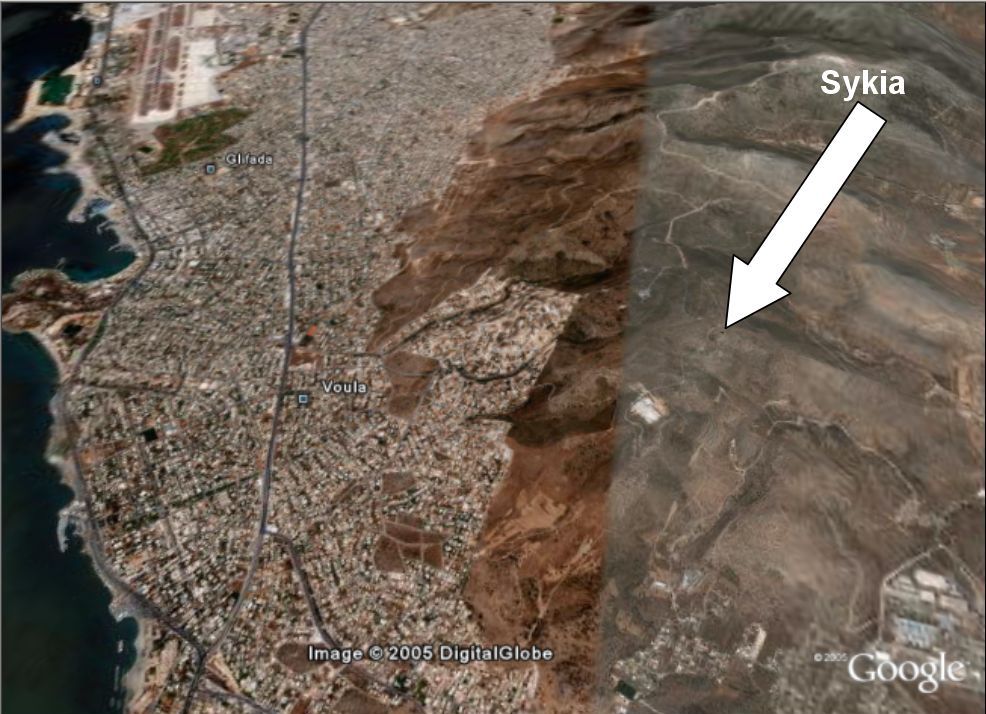 Google Earth image of Southern Hymettus
It's only a 17m drop. Descending and ascending shouldn’t put too much strain on the ankle.
11 December 2005
Andritsa Cave, Fateful Refuge
So, we went to the "Andritsa Cave, Fateful Refuge" exhibition at the Byzantine and Christian Museum of Athens at the weekend.
There's been a lot of angst in the caving community over this and especially about the ethics of exploration and a whole bunch of other stuff. Friendships have been strained and there has been renewed discussion amongst ourselves about the legal framework within which everything is operating. Not having any personal stake in any of this and not being able to see how it could impact my own future activity, I will not go into details of how the cave was found, explored and presented for exhibition.
 The cave itself seems to be a single largish chamber on many levels accessible through a vertical drop of some meters wide enough for one person to climb in and out at a time.
At some point soon after 575 or 576 AD, at least 33 individuals, mainly women and children, entered the cave carrying their everyday personal belongings (coins, small knives); many jugs for liquids but no utensils for the preparation of food; and a processional bronze cross with the Lord's Prayer inscribed on both sides.
The lack of provision for the preparation of food indicates that either they expected that they would be out again soon, or that they knew they were going into the cave to die. For some reason they never made it out and each one died where they were found some 1,400 years later by cavers exploring in that part of Greece.
What happened we shall probably never know. It was a bad time for the Roman Empire. The West had been overrun by the Goths about a hundred years before, very much with the collusion of the Roman Senatorial families who disliked being governed from Constantinople. Barbarian raids had been commonplace in the Greek mainland for years with Slavs and other pagan races entering and raiding the peninsula from the north. The holy land and parts of the east had been overrun by the Persians and wars had raged there for many years. To add to this upheaval, there had been a series of sometimes bloody religious disagreements over the nature of Christ (and the singularity or duality of his nature) which had upset the empire and which had coincided with a whole bunch of plagues as well.
Our 33 individuals could have been hiding from anything in these times, with their processional cross. None of the corpses was plundered - each was found with their money in the light soil around the bones. If anyone had expected to make it back out to the surface, presumably they would have emptied the pockets of the dead. If anyone had made it out, the same applies. Given that the bronze artifacts were left behind, it does not seem likely that anyone came out. Either they became trapped and could not exit when someone took their ladder, or they had no intention of coming out once they had entered.
One curious thing is the absence of graffitos or dipintos on the walls of the cave or on the ceramic jugs that they had with them. No one made an effort to record anything in writing, not even a final prayer before dying. Such a thing would help solve the mystery of who and why. Of course, it could be that all those in the cave were illiterate - something not inconceivable (most were probably female - the location is far from urban centres). I do not have information about literacy at this time. Whatever the case, letting the imagination go and sitting in with them is interesting.
The first few have died and we can see the others moving to other parts of the cave, away from the first dead, to find a place where they too can die. Did they have oil left in their lamps or were they in the semi darkness? Why were some of the water jars broken? Clumsiness in use in the darkness? Purposeful breaking of the now empty jars (ritual killing)? Or perhaps the act of a desperate person who through breaking the now empty water jars can give some externalization to their grief, brought on by realization that death is nearby?
For the archaeologist, the cave gives what we call a sealed assemblage - we know that everything in the cave was deposited at the same time - this is great because we have coins and other artifacts the use of which can all be assigned to the same period. Some interesting things which come out of the finds are that the lamps used are imitations of the so-called North African type. The cross is of the Latin type with arms flaring out into disc shaped finials (which you can't really see in the photo). There were coins spanning a period of about 80 years found on the bodies - but unfortunately there is no information yet about which mints pressed the coins. A 20 nummi coin is shown in the photo - the "K" face visible. One gift from the cave which cannot today be overlooked is the information which can be gathered from the bones themselves - stick them in a mass spectrometer and find out what these guys were eating - just like they have done with skeletons from the Bronze Age. Something about nitrogen isotope ratios in bone showing differences according to diet.
The exhibition was nicely laid out and shows the amazing progress made by the museum in this field: good lighting, good explanations, nicely translated texts. I hope there are follow-ups done on the materials excavated and that these will be announced in due course.
There's been a lot of angst in the caving community over this and especially about the ethics of exploration and a whole bunch of other stuff. Friendships have been strained and there has been renewed discussion amongst ourselves about the legal framework within which everything is operating. Not having any personal stake in any of this and not being able to see how it could impact my own future activity, I will not go into details of how the cave was found, explored and presented for exhibition.
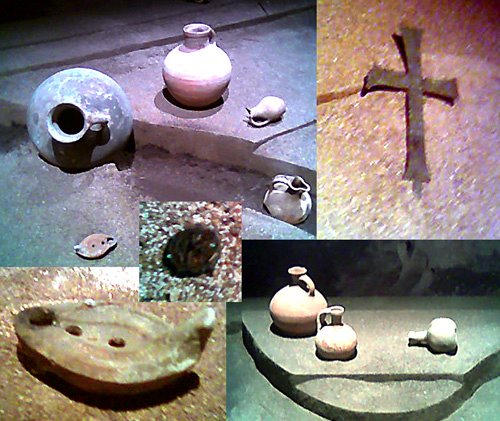 The cave itself seems to be a single largish chamber on many levels accessible through a vertical drop of some meters wide enough for one person to climb in and out at a time.
 At some point soon after 575 or 576 AD, at least 33 individuals, mainly women and children, entered the cave carrying their everyday personal belongings (coins, small knives); many jugs for liquids but no utensils for the preparation of food; and a processional bronze cross with the Lord's Prayer inscribed on both sides.
The lack of provision for the preparation of food indicates that either they expected that they would be out again soon, or that they knew they were going into the cave to die. For some reason they never made it out and each one died where they were found some 1,400 years later by cavers exploring in that part of Greece.
What happened we shall probably never know. It was a bad time for the Roman Empire. The West had been overrun by the Goths about a hundred years before, very much with the collusion of the Roman Senatorial families who disliked being governed from Constantinople. Barbarian raids had been commonplace in the Greek mainland for years with Slavs and other pagan races entering and raiding the peninsula from the north. The holy land and parts of the east had been overrun by the Persians and wars had raged there for many years. To add to this upheaval, there had been a series of sometimes bloody religious disagreements over the nature of Christ (and the singularity or duality of his nature) which had upset the empire and which had coincided with a whole bunch of plagues as well.
Our 33 individuals could have been hiding from anything in these times, with their processional cross. None of the corpses was plundered - each was found with their money in the light soil around the bones. If anyone had expected to make it back out to the surface, presumably they would have emptied the pockets of the dead. If anyone had made it out, the same applies. Given that the bronze artifacts were left behind, it does not seem likely that anyone came out. Either they became trapped and could not exit when someone took their ladder, or they had no intention of coming out once they had entered.
One curious thing is the absence of graffitos or dipintos on the walls of the cave or on the ceramic jugs that they had with them. No one made an effort to record anything in writing, not even a final prayer before dying. Such a thing would help solve the mystery of who and why. Of course, it could be that all those in the cave were illiterate - something not inconceivable (most were probably female - the location is far from urban centres). I do not have information about literacy at this time. Whatever the case, letting the imagination go and sitting in with them is interesting.
The first few have died and we can see the others moving to other parts of the cave, away from the first dead, to find a place where they too can die. Did they have oil left in their lamps or were they in the semi darkness? Why were some of the water jars broken? Clumsiness in use in the darkness? Purposeful breaking of the now empty jars (ritual killing)? Or perhaps the act of a desperate person who through breaking the now empty water jars can give some externalization to their grief, brought on by realization that death is nearby?
For the archaeologist, the cave gives what we call a sealed assemblage - we know that everything in the cave was deposited at the same time - this is great because we have coins and other artifacts the use of which can all be assigned to the same period. Some interesting things which come out of the finds are that the lamps used are imitations of the so-called North African type. The cross is of the Latin type with arms flaring out into disc shaped finials (which you can't really see in the photo). There were coins spanning a period of about 80 years found on the bodies - but unfortunately there is no information yet about which mints pressed the coins. A 20 nummi coin is shown in the photo - the "K" face visible. One gift from the cave which cannot today be overlooked is the information which can be gathered from the bones themselves - stick them in a mass spectrometer and find out what these guys were eating - just like they have done with skeletons from the Bronze Age. Something about nitrogen isotope ratios in bone showing differences according to diet.
The exhibition was nicely laid out and shows the amazing progress made by the museum in this field: good lighting, good explanations, nicely translated texts. I hope there are follow-ups done on the materials excavated and that these will be announced in due course.
02 December 2005
Winter visit to Dersios
On Sunday 27 November, Nikos Mitsakis and Komninos Boutaras went up to Palaiochora for a day trip to have a look at the sinkhole in the winter and de-rig after my accident. The roaring sound of the river flowing into the sinkhole and draining most of the plateau could be heard from the road.
The water goes down to the junction with the second sidebranch and then (as predicted by Komninos during the summer) it turns left into the sidebranch where it ends up at the sump in a mess of frothing and noise.
Some of the water carries on towards the first sump, but disappears before the little transervse section, and then reappears after the "screw". From there it makes its way to the first sump.
At the first sump, there was a clear froth line at the level to which the sump usually fills, but the water in the sump was very low, just a little higher than during the summer. This means that to date this winter the hose trick is working, despite the sump having filled to the brim since we left the system in place.
I'm just trying to picture some scenes in my mind's eye - like how the water would flow through the narrow passage in the sidebranch, how the waterfall would shoot water out of it at the end of the passage, and what the junction at -151m between the sidebranch and the main route would look in full flow… but we will probably never have a chance to see any of this.
After the mission, we now have a much clearer picture of which areas are prone to flooding in case of sudden rainfall, but we also have a better picture of the hydrological situation in the cave.
PS - what do people think? Is it coincidence that the bats prefer to nest in the parts of the sinkhole in which there is no running water - ie in the chamber before the traverse over tha small lake and in the screw?
The water goes down to the junction with the second sidebranch and then (as predicted by Komninos during the summer) it turns left into the sidebranch where it ends up at the sump in a mess of frothing and noise.
Some of the water carries on towards the first sump, but disappears before the little transervse section, and then reappears after the "screw". From there it makes its way to the first sump.
At the first sump, there was a clear froth line at the level to which the sump usually fills, but the water in the sump was very low, just a little higher than during the summer. This means that to date this winter the hose trick is working, despite the sump having filled to the brim since we left the system in place.
I'm just trying to picture some scenes in my mind's eye - like how the water would flow through the narrow passage in the sidebranch, how the waterfall would shoot water out of it at the end of the passage, and what the junction at -151m between the sidebranch and the main route would look in full flow… but we will probably never have a chance to see any of this.
After the mission, we now have a much clearer picture of which areas are prone to flooding in case of sudden rainfall, but we also have a better picture of the hydrological situation in the cave.
PS - what do people think? Is it coincidence that the bats prefer to nest in the parts of the sinkhole in which there is no running water - ie in the chamber before the traverse over tha small lake and in the screw?
Subscribe to:
Posts (Atom)

